MPACT Faces China Property Pressure as Divestments Stall and Singapore Assets Support Income
MPACT’s China properties face falling rents and valuations as sales prove difficult. VivoCity’s growth and planned upgrades offer support amid overseas weakness.
Weak leasing conditions in China are weighing on Mapletree Pan Asia Commercial Trust (MPACT), while subdued buyer interest is making it harder to sell properties on terms the manager considers acceptable. Singapore assets, led by VivoCity, continue to support income as the trust works through pressure across parts of its overseas portfolio.

“China is our biggest pain,” Sharon Lim, chief executive of MPACT’s manager, said at an earnings briefing on Friday, Oct 30. She expects conditions there to remain weak over the next year or so. The manager would like to sell some China assets, she said, but has to take a long-term view and weigh offers against the properties’ prospects.
China rents and values remain under pressure
MPACT’s China portfolio consists of Gateway Plaza, an office development in Beijing’s Lufthansa district, and Sandhill Plaza, a business park in Shanghai’s Zhangjiang Science City. Together, the properties represent about 9 per cent of the trust’s assets under management (AUM).

For the first half ended September, they generated S$26 million in net property income (NPI), down about 15.9 per cent from S$30.9 million a year earlier. Committed occupancy was 84.5 per cent and tenant retention was 78.7 per cent. Rental reversion, which measures the change in rent on renewed and new leases, was minus 29.9 per cent.
Fresh supply is adding to the strain. In the third quarter of 2026, overall office rents in Beijing fell 4.1 per cent on the quarter, while occupancy declined to 80.3 per cent. Shanghai business park rents slipped 1 per cent, even as occupancy improved to 70.5 per cent, according to the manager.

About 700,000 square metres of office space is expected to enter the Beijing market, alongside 2.8 million square metres of business park space in Shanghai, over the rest of 2026 through 2028. That pipeline may limit landlords’ ability to raise rents while tenants have more options.

Property values have also fallen. At the end of March 2026, Gateway Plaza was valued at 5.3 billion yuan (US$795.8 million), an 8.5 per cent year-on-year decline in local-currency terms. Sandhill Plaza’s valuation dropped 4.7 per cent to 2.1 billion yuan.

Sales depend on price and buyer appetite
MPACT has sold about S$1.2 billion of properties over the past two years. Lim said previous disposals reflected factors including attractive offers and management’s efforts to address expected tenancy challenges before they hurt performance.

The conditions for further sales are tougher. Higher financing costs and limited buyer interest have made transactions harder to complete. Although the manager remains interested in selling weaker assets, Lim said it would prefer to retain some properties rather than accept “huge haircuts” on sale prices. MPACT plans to keep improving property performance while exploring disposals, without setting a fixed timetable.

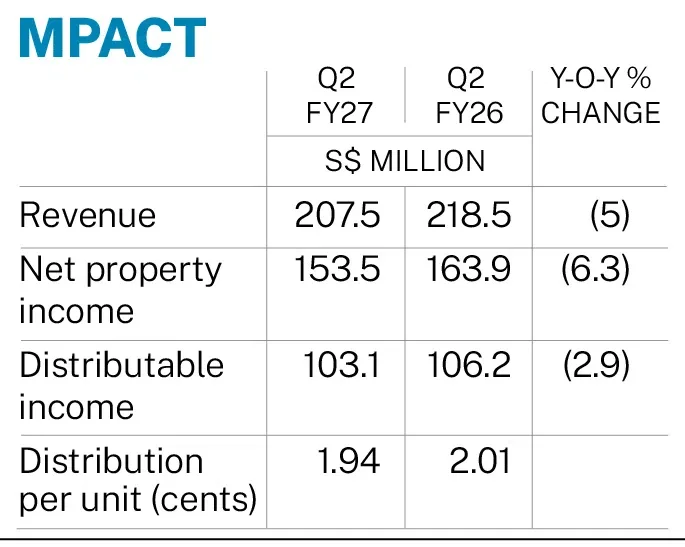
The trust’s second-quarter distribution per unit (DPU) fell 3.5 per cent to S$0.0194 from S$0.0201 a year earlier. Lower contributions from overseas properties and the absence of income from sold assets drove the decline. Lower finance expenses and stronger VivoCity performance partly offset those pressures.
Singapore income offsets overseas weakness
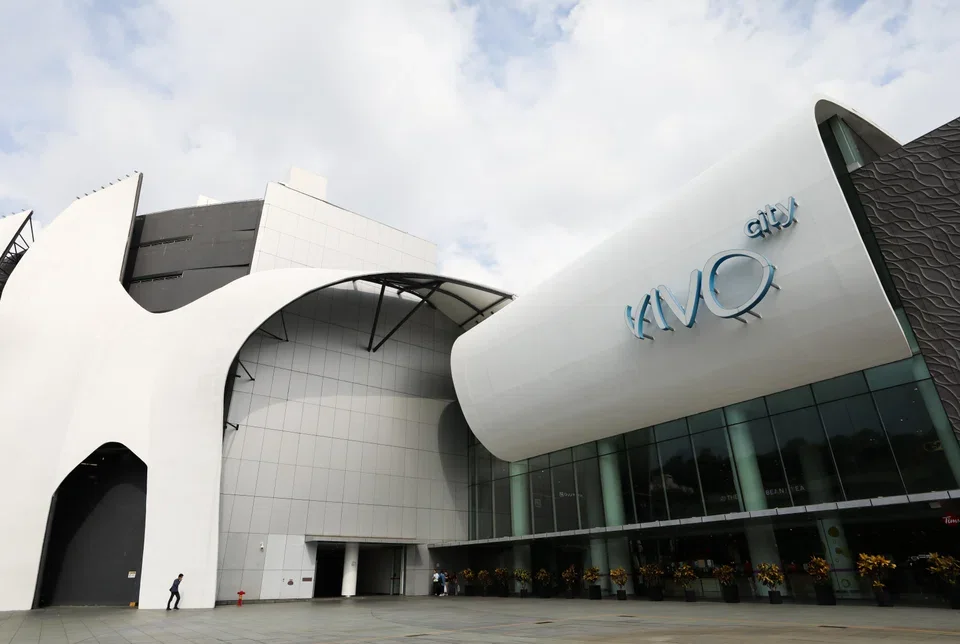
Singapore accounts for 61 per cent of MPACT’s S$15.3 billion portfolio AUM and contributed 68 per cent of first-half NPI. VivoCity recorded 15 per cent positive rental reversions, full committed occupancy and 4.1 per cent year-on-year growth in tenant sales during the half. Its NPI rose 6.9 per cent after refurbishment work at Basement 2 was completed.
Two further asset enhancement initiatives at VivoCity are in advanced planning, though the manager has not set an implementation timetable. The proposals include creating a retail cluster near the mall’s drop-off point, using areas connected to the hypermarket and H&M premises, and reallocating underused floor space to higher-yielding retail uses. Lim said the manager is confident in the expected results and plans to continue with work it considers worthwhile.
Mapletree Business City could also add rental income. Its committed occupancy reached 95.4 per cent at the end of September, up from 94.3 per cent three months earlier. About 6 per cent of its space had been newly committed but was not yet producing rent; most of those leases were expected to begin contributing from Nov 1.
Japan leasing and Hong Kong repositioning
In Japan, the non-renewal of the lease at Fujitsu Makuhari Building has reduced rental contributions. Committed occupancy across MPACT’s seven Japanese properties stood at 57.5 per cent at the end of September, compared with 73.9 per cent a year earlier. Tenant retention was 70.6 per cent, while rental reversion was 2.4 per cent.
Three of the seven assets are in Makuhari. The manager said leasing inquiries there have increased from one or two years ago, as rising rents in central Tokyo prompt some companies to consider lower-cost locations. Prospective tenants are now looking at spaces of 50,000 to 100,000 square feet, rather than mainly seeking smaller units. MPACT is in early discussions with several potential tenants, including one for Fujitsu Makuhari Building. Filling the vacancy could improve the property’s prospects for a future sale.
At Hong Kong’s Festival Walk, MPACT is considering changes after first-half rental reversions of minus 15.6 per cent. Tenant sales rose 3.9 per cent year on year and committed occupancy remained near full. Plans include reducing the cinema’s size, converting some of its space to food and beverage outlets, and dividing larger retail units for tenants seeking smaller premises. Lim expects a positive return, while acknowledging some downtime next year.
Lim did not forecast whether DPU would keep falling over the next two years. She cited continued weakness in China, the effect of Fujitsu’s departure on year-on-year NPI comparisons, and possible disruption from further VivoCity upgrades. Her message was that management must keep improving individual properties even when broad market conditions are difficult.