AI in HR centres on hiring, but human review remains common in Singapore
SNEF’s survey found recruitment led workplace AI use, while 85% of reported HR applications still involved human input.
Hiring leads workplace AI use
Artificial intelligence is taking root in Singapore employers’ HR operations, with recruitment and selection the most common application. Yet the technology has limited authority over many reported processes: 85 per cent of AI-supported HR use cases still involved a person, according to a Singapore National Employers Federation (SNEF) survey released on Oct 30.

The findings point to a two-track transition. Employers are using AI to speed up tasks such as candidate screening, while keeping people involved in decisions that affect workers. For HR teams, the challenge is to capture efficiency gains without weakening professional skills or blurring responsibility for outcomes.
SNEF surveyed 1,000 employers between June and July. The group included small and medium-sized enterprises (SMEs) with 200 or fewer employees, and large enterprises with more than 200. The results were presented at the SNEF Employers’ Summit 2026, where the federation also introduced support for companies adopting AI and developing HR capabilities.

Adoption varies by company size and task
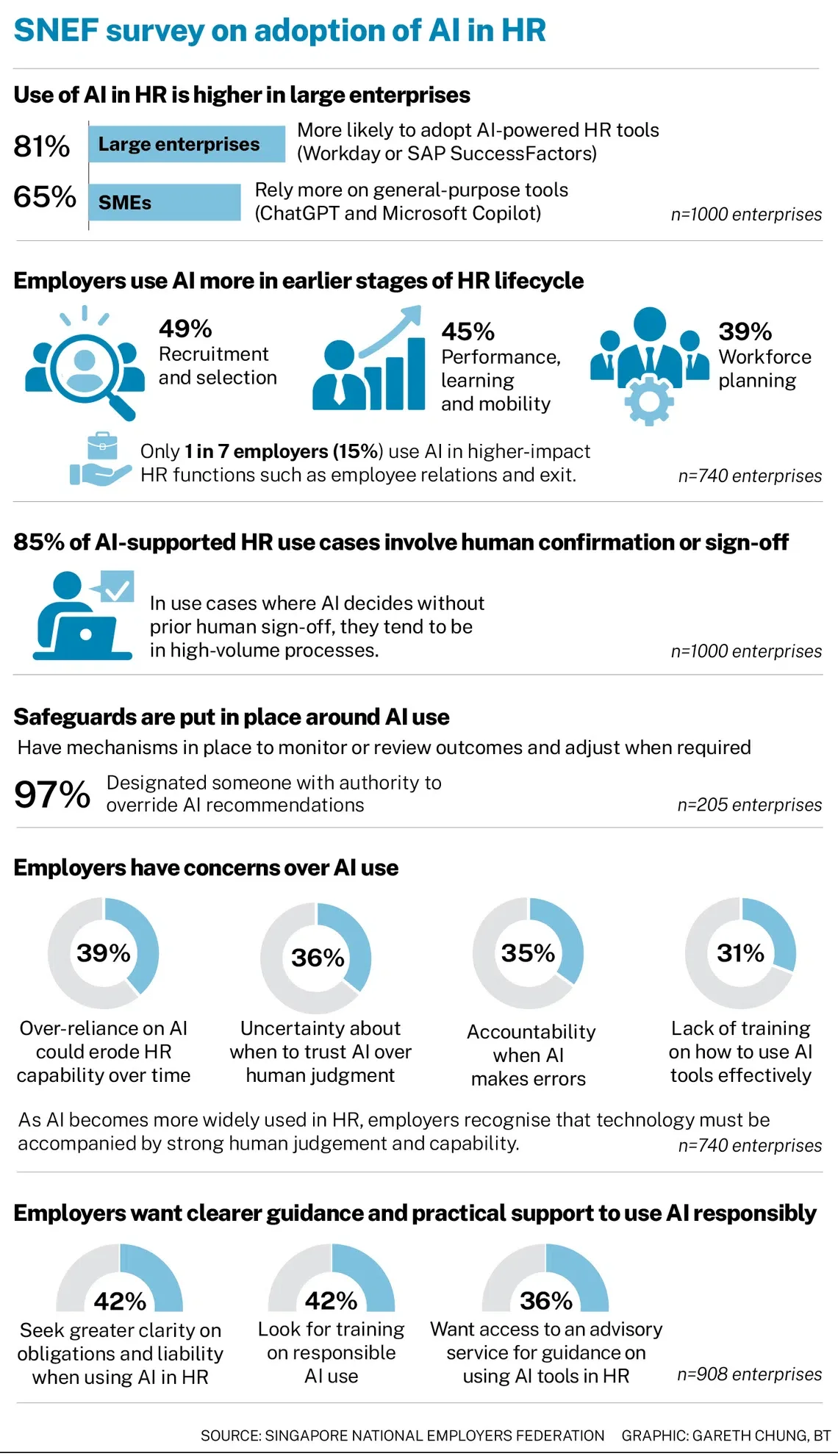
Large enterprises were more likely than SMEs to use AI in at least one HR function: 81 per cent reported adoption, compared with 65 per cent of SMEs. Their tool choices also differed. Larger companies were more likely to use HR platforms such as Workday and SAP SuccessFactors; SMEs more often used general-purpose products including ChatGPT and Microsoft Copilot.
Use is concentrated in several parts of the HR cycle. Recruitment and selection, including screening and shortlisting candidates, accounted for 49 per cent of reported applications. Performance, learning and mobility made up 45 per cent, covering areas such as performance management and internal mobility decisions. Workforce planning represented 39 per cent, including demand forecasts and efforts to identify skills gaps.

By comparison, only 15 per cent of employers used AI for higher-impact functions such as examining the causes of employee relations issues or staff departures. That gap suggests adoption is most established where processes are repeatable and outputs can support existing work, while more sensitive analysis remains less common.

People retain authority over most reported uses
Across nearly 3,000 reported instances of AI use in HR, 15 per cent involved the technology making a decision without prior human sign-off. Nearly three-quarters of those instances, or 73 per cent, concerned routine or high-volume administrative work, including resume screening and skills assessments.
Even in this group, employers generally named someone who could step in: 97 per cent of employers using AI without prior human review had assigned a person with authority to change or reverse a decision. In the other 85 per cent of use cases, some human involvement was built into the process.
The reported roles varied. AI supplied information only in 14 per cent of cases and recommended options for a person to decide on in another 36 per cent. In 35 per cent, AI made a decision that still needed a person to approve, reject or override it. These figures show that “AI use” covers different levels of influence, from assistance to a provisional decision subject to review.

Employers’ concerns reflect that spread. The most cited issue was the risk that over-reliance on AI could erode HR capabilities, reported by 39 per cent of employers using the technology. Uncertainty about when to trust AI over professional judgment concerned 36 per cent, while 35 per cent cited accountability for AI errors. Mental fatigue from managing AI outputs was the least common concern, at 20 per cent.
Fair hiring and employer support
Recruitment tools raise questions about whether screening systems treat applicants fairly, including older jobseekers who may be less familiar with AI. SNEF’s outgoing chief executive, Hao Shuo, said applicants could use AI to improve their resumes, while employers needed to check that screening tools did not introduce bias. He also said HR professionals would remain the ultimate decision-makers in hiring.

The survey found that 84 per cent of employers using AI were highly familiar with at least one relevant legal or governance framework. Still, familiarity does not settle the practical questions of how systems work, when human review is needed and who is answerable when an automated process produces an error.

SNEF president Kuah Boon Wee said 42 per cent of employers wanted clearer guidance on their obligations and liabilities, and an equal share sought training in responsible AI use. He said the federation could offer advisory services and connect employers with suitable partners, while acknowledging that no organisation has every answer.
The federation’s new AI-HR pre-scoped solution combines human capital advice, AI tools for HR processes, workforce transformation consultancy and skills analytics. Examples include chatbots for routine employee questions and tools to identify skills gaps or support succession planning.
Through the Workforce Development Grant (Job Redesign+), SNEF will assess company needs and match employers with specialist consultants. Funding can cover up to 70 per cent of qualifying costs for SMEs and 50 per cent for non-SMEs, capped at S$150,000 per project. BDO, Elitez, EON, PwC and Skybots have been appointed to support the initiative.
Hao said the measure of success should be whether HR professionals can contribute more to business strategy and workforce transformation, rather than how many tasks AI performs. For employers, the next test is whether efficiency in routine work translates into stronger HR judgment and a clearer strategic role.


