Remodeling Costs and Delays Make Finished Homes More Competitive
Long timelines and rising project costs can erase the fixer discount, making a finished home worth considering for buyers weighing time and expense.
For buyers considering a major renovation, the purchase price of a fixer can hide the biggest costs: years of delay, rent elsewhere and cash tied up while work stalls. In cities where construction moves slowly, a finished home may be financially competitive even when its asking price is higher.
That tradeoff is especially relevant to buyers with limited time for a prolonged project. Two gut renovations and several bathroom projects in San Francisco have left me wary of relying on a contractor’s initial estimate. My last full renovation began in mid-2019 and wasn’t completely finished until the end of 2022. The pandemic added about six months, but the project still took roughly three years after I had expected no more than one. I could use the upstairs while work on the ground floor dragged on; that option won’t exist for every household.
Construction time varies widely by city
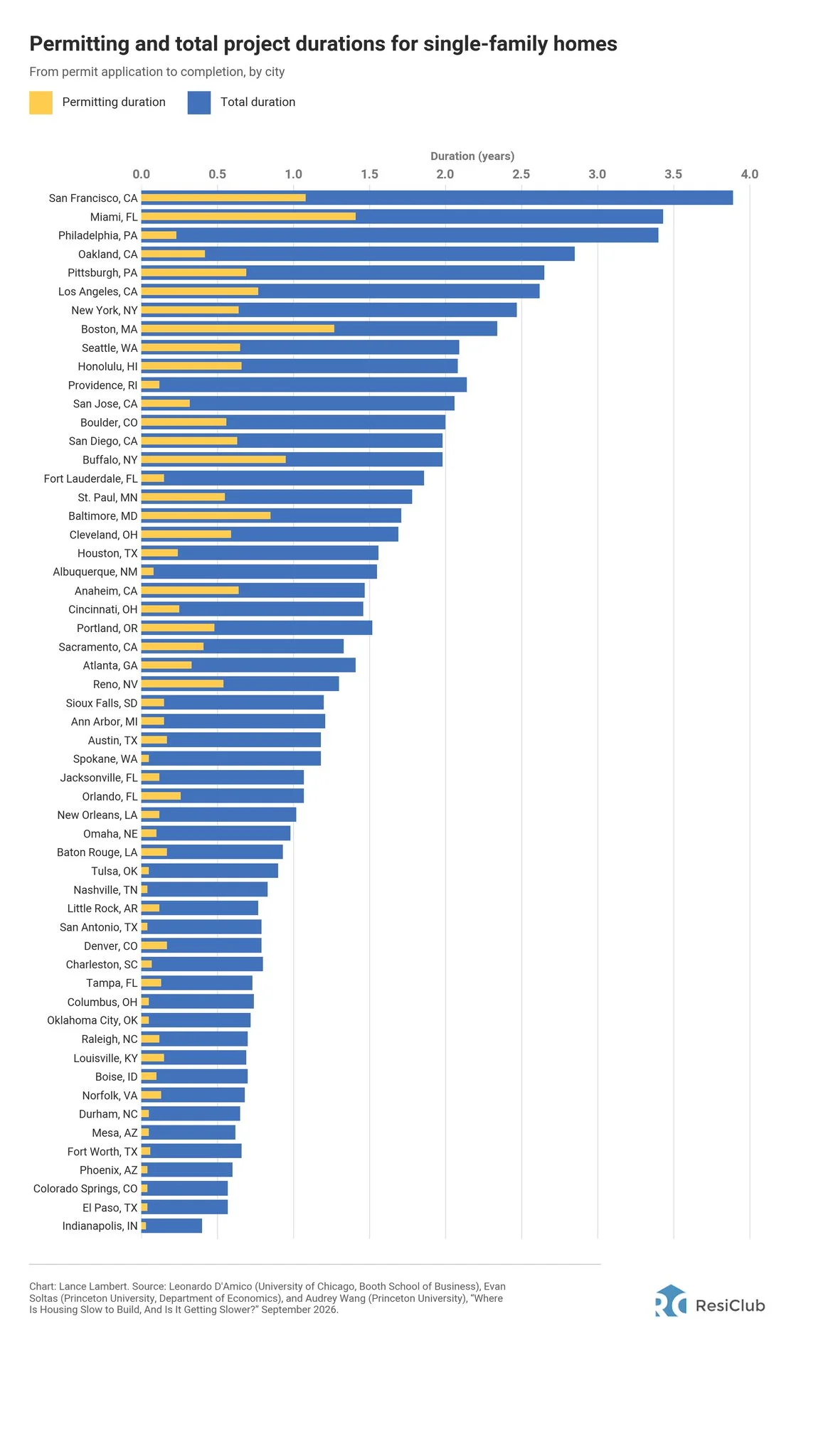
A chart compiled by ResiClub from research by University of Chicago and Princeton professors, titled “Where Is It Slow To Build, And Is It Getting Slower?”, compares the time needed to obtain a permit and complete a new single-family home.
San Francisco ranks slowest in the chart, with an average of 1.1 years to get a permit and 3.8 years to finish a single-family home. Miami and Philadelphia take about 3.4 years. Indianapolis, El Paso and Colorado Springs are at roughly six months. Across the country, the average from permit application to completion is about 8.8 months.
The spread makes location central to the fixer calculation. A family in Indianapolis could complete several homes in the time a San Francisco household waits for one. The national permitting timeline has also lengthened: the average for single-family projects rose from 1.6 months in 2000 to 4.9 months in 2023.
The price tag leaves out major expenses
Consider a buyer paying $1.6 million for a fixer and setting aside $400,000 for an 18-month gut renovation. If the budget rises by 50% to $600,000 and the work lasts 2.5 years, the extra costs mount quickly. Rent at $6,500 a month adds $195,000 over that period. Property tax at roughly 1.2% adds about $48,000 on a home the buyer can’t occupy.
Those expenses put the total near $2.44 million, before accounting for the opportunity cost of keeping roughly $850,000 tied up in the purchase and renovation. That money could otherwise have been invested elsewhere, though its eventual return is uncertain. The calculation also excludes the disruption of living in a rental, coordinating the work and waiting for a home to become usable.
Time has a personal cost, too. Children who are five and seven when a project begins will be eight and ten by the time a three-year renovation ends. Those years can’t be recovered by finishing the kitchen to specification.
The fixer discount is getting thinner
In San Francisco, fully renovated homes appear to sell without a large enough premium to reflect the time and risk of doing the work yourself. The same dynamic may apply in other places where construction is slow. An illustrative comparison shows the potential savings from buying a fixer and renovating it declining from roughly $250,000 a decade ago to about $60,000 today.
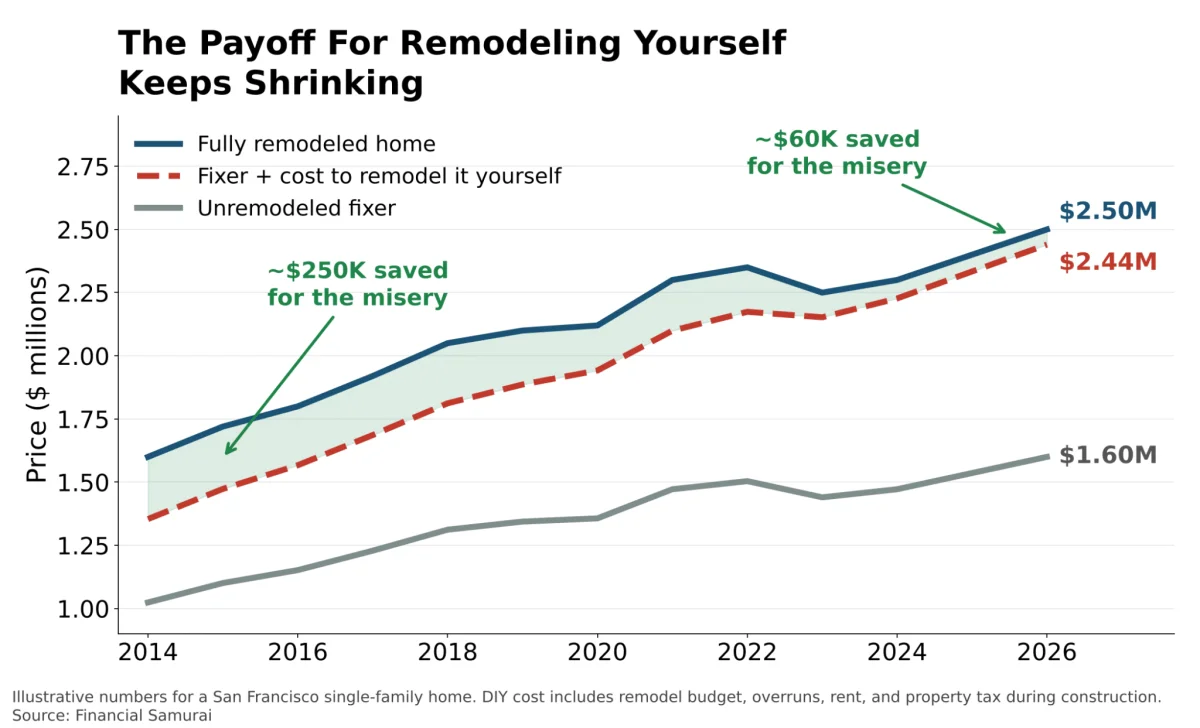
Higher labor and material costs, along with longer permitting timelines, can narrow the gap. A $60,000 difference spread across 2.5 years amounts to about $2,000 a month before counting the time spent managing contractors or the cost of renting elsewhere. One delayed shipment, a subcontractor problem or an extended permit review could consume the remaining savings.
These figures are examples, not a universal estimate. Local rents, property taxes, purchase prices and project scope all change the result. The useful comparison is between the full cost of each path: buying finished, or buying a fixer and adding construction, housing and carrying expenses.
Why buyers still take on major work
Some buyers underestimate the coordination involved. A strong résumé or a reliable general contractor can’t eliminate the chain of dependencies that makes construction vulnerable to delays. A missing bathroom part can hold up a room for a month. A custom cabinet may arrive cracked or fail to fit. Different inspectors may ask for different corrections. A window that passes a hose test may still leak during a hard rain.
Other problems are less predictable: tile installed crooked, a shower membrane omitted, a neighbor upset by noise, or a contractor shifting attention to another job. Any one issue can disrupt the next stage. If work has to be corrected before it can be covered, later trades may have to wait as well.
Personal taste is a more compelling reason to remodel. Finished homes are usually designed for broad appeal: light wood floors, pale counters and restrained fixtures. A buyer who wants a vivid kitchen, a hidden room or a Japanese soaking tub with a view may not find those details already in place.
But customization carries both a cost and a resale tradeoff. Paint, lighting, furniture, art and landscaping can make a home feel distinctive for less time and money than a structural renovation. Highly personal choices may also narrow the pool of future buyers. A dream home can look like a future gut project to someone else.
Buying finished still leaves some construction nearby
A renovated house doesn’t guarantee a quiet block. In desirable neighborhoods, new owners may have the resources and appetite to remake older homes. Five nearby households began major renovations in less than a year around my home. Even after buying a finished property, residents can still hear saws and jackhammers from the next project.
The distinction is that the finished-home buyer may avoid paying for and managing that work personally. For me, that’s a trade worth making. A conversation with a friend about building a $4 million home from scratch covers some of the same practical challenges: listen on Apple Podcasts or Spotify.
Planning for a renovation
Buyers who choose a fixer can reduce avoidable surprises, though no plan removes the risk of delays. Start with a general contractor who has recently completed projects in the same city. Ask how many jobs reached final sign-off in the past two years and speak with former clients. Local experience matters because each city has its own permitting process.
Consider hiring a permit expediter in a slow-moving city. Order long-lead items, including windows, custom cabinets and specialty fixtures, before demolition begins. Set aside a 50% contingency, as cost estimates can prove optimistic. And decide early where the household will live during construction. Moving through the home as separate areas are completed may work for some projects; otherwise, rent and the carrying cost of the property belong in the budget.
Despite the strain, a finished renovation can bring real satisfaction. Plumbing, electrical and building work may each need inspection more than once before crews can close up a wall. Reaching the end means seeing all those pieces come together. Work that adds livable space or stays within a reasonable budget may recover at least 80% of its cost. In some markets, the return may exceed 100%, though results depend on the home and local demand.
For buyers comparing a fixer with a finished property, the key question is what the discount pays for after rent, taxes, delays and uncertainty. When the savings have narrowed to around $60,000, that may be a small reward for years of coordination. The finished home can preserve time and reduce exposure to construction overruns, while cosmetic changes leave room for personal style.


