Japan to Reduce Fuel Subsidies as Energy Costs Strain Households
Japan will raise subsidised fuel prices by 5 yen a litre monthly from December, easing public costs while adding pressure on households and businesses.
Japan’s gradual retreat from fuel subsidies shifts more of the energy shock onto motorists and businesses, while offering relief to public finances. From December into early spring, the benchmark retail fuel price will rise by 5 yen (US$0.03) a litre each month, Japan’s leader Sanae Takaichi said on Thursday (Oct 29). She did not give a date for ending the programme entirely.

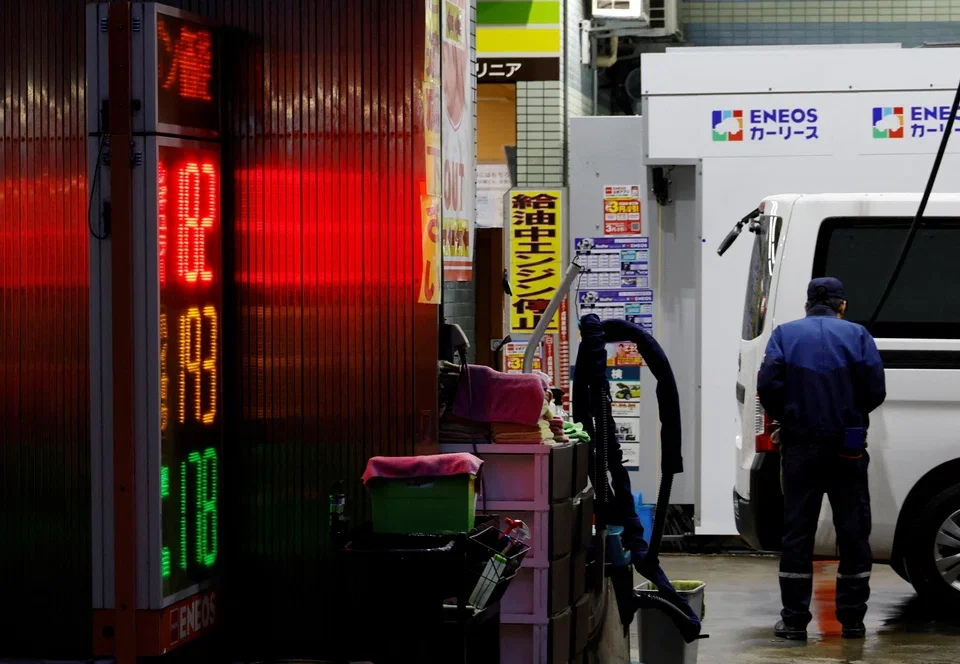
The change follows an intervention that kept petrol prices around 170 yen a litre, equivalent to about US$4.10 a gallon. Japan has also supported prices for diesel and kerosene. The measures have softened the immediate effect of higher energy costs, but the bill has been substantial: an estimated 1.2 trillion yen (US$7.6 billion) went to petrol and diesel subsidies from mid-March through September, according to BloombergNEF.
A costly buffer against imported energy
Japan entered the current energy shock with heavy exposure to overseas crude. Before the conflict, the Middle East supplied more than 90 per cent of the country’s crude needs. Tokyo has drawn on strategic reserves, and refiners have had to secure costlier alternatives, particularly from the US. Those pressures make the subsidy’s price protection valuable to fuel users, but expensive to sustain.

The price-support mechanism dates to 2022, when economies were emerging from the pandemic. It was expanded as Russia’s invasion of Ukraine unsettled energy markets, then continued in changing forms. Tokyo increased the assistance sharply after the Iran war began in late February.

The design has distinguished Japan’s response from measures elsewhere. Some countries used temporary fuel-tax reductions; Japan instead absorbed costs above a benchmark to keep retail prices near a target. That approach offers consumers a more direct price cushion, while placing a larger and less visible cost on public finances. It can also benefit people and businesses that use more fuel more than those with lower consumption.

Takahide Kiuchi, a former Bank of Japan board member and executive economist at the Nomura Research Institute, wrote in an Oct 27 note that the programme costs hundreds of billions of yen a month. He said additional funding comes from a budget financed entirely by deficit-covering bonds. Kiuchi also argued that the support is poorly targeted and that concerns over fiscal expansion could weaken the yen, adding to inflationary pressure.

Relief shifts across energy bills
Reducing fuel support may limit further public spending, but it arrives while households and companies are already dealing with persistent price increases. Japan endured decades of largely stagnant prices before the current inflation period, and a higher pump price feeds directly into commuting and delivery costs. Businesses that rely on transport or fuel-intensive operations may face a similar squeeze, with the eventual effect depending on how much of the increase they absorb or pass on.

The Consumer Union of Japan, a nongovernmental body representing grassroots consumers, has opposed the planned reduction. Eiji Hara, a co-representative, said ending the support while households and businesses face higher prices and fuel costs “would deal a major blow to their livelihoods and operations.” That criticism highlights the central trade-off: a broad price buffer is costly and uneven, but withdrawing it can make an existing cost-of-living strain more acute.
Tokyo is pairing the fuel changes with earlier help on other energy bills. Electricity and gas subsidies will begin a month sooner, in December. Takaichi said a typical household would receive about 7,000 yen in relief through February. The measure may offset some utility costs, though it does not directly keep petrol, diesel or kerosene prices at their current levels.
What to watch in the phase-down
The monthly 5 yen increase sets a pace for the initial adjustment, but the end point remains unspecified. For households, the timing and full extent of the price changes will determine how quickly fuel costs rise. For businesses, the impact will depend on fuel use and their ability to adjust prices, routes or operations. For public finances, the scale of savings will turn on how long the subsidy continues and how energy prices evolve.
Japan’s response therefore moves from broad fuel-price protection toward a mix of gradual increases and temporary utility assistance. The key measure will be how the phase-down progresses alongside imported energy costs: reducing the subsidy can ease its fiscal burden, while leaving consumers and fuel-dependent firms more exposed to price movements.
===

