Derivatives Firms Weigh Perpetual Futures as 24/7 Client Demand Remains Limited
Most surveyed firms reported stronger first-half performance, but interest in round-the-clock trading remains uneven and implementation hinges on risk, liquidity and infrastructure.


Derivatives firms entered the second half of 2026 with stronger performance than a year earlier, while weighing whether products and infrastructure built for always-on markets fit their clients’ needs. Acuiti’s survey points to a split: perpetual futures are moving onto sell-side agendas, but broad institutional demand for 24/7 trading has yet to emerge.
In Acuiti’s inaugural Q3 2026 Derivatives Management Insight Report, two-thirds of respondents said their businesses performed better in the first half of 2026 than in the same period of 2025. Just 12% reported weaker performance year over year. Against an average year, 64% performed better, with 31% describing the period as significantly better.
Results also exceeded many firms’ own plans: 52% said they beat budget, including 16% who significantly outperformed it. By comparison, 19% fell short. Acuiti said sell-side respondents reported above-average performance relative to the wider listed derivatives market.
That performance came alongside operating pressures. Third-party technology vendor costs affected the largest share of respondents, followed by exchange fees. Regulation was a significant or critical challenge for 34%, including 11% who called it critical. Finding skilled staff was a significant or critical concern for 35%, and rising salaries weighed on another quarter.
Perpetual futures draw interest, with risk models a hurdle
Among institutional execution desks, 16% already offer perpetual futures. A further 10% are developing an offering, while 37% are considering one. The remaining 37% aren’t considering the products. Acuiti described perpetual futures as becoming an increasingly visible part of traditional finance.
For firms exploring the contracts, product design brings practical questions that differ from conventional futures. Risk management and modelling topped the list of challenges, particularly the treatment of funding rates. Respondents also pointed to the need to establish suitable margin methods and secure dependable liquidity. Those requirements shape whether an offering can work for institutional clients, beyond the decision to list or route the product.
Client interest in round-the-clock markets is limited
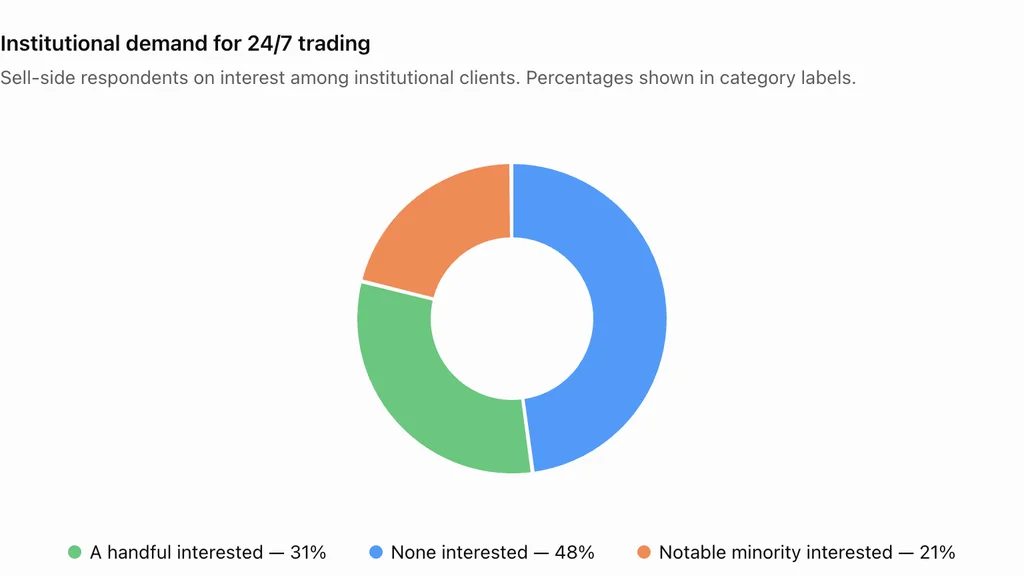
Demand for 24/7 trading among institutional clients appears less developed. Nearly half of sell-side respondents, 48%, said none of their institutional clients were interested. Another 31% saw interest from a handful of clients, while 21% reported a notable minority. No respondent said a majority of clients wanted the functionality.

In a report Q&A, Stephanie Peritore, Head of International Sales at Fidelity Digital Assets, said continuous trading challenges the assumptions behind established market infrastructure. Extending current processes across more hours won’t, by itself, meet the need, she said; operating around the clock calls for infrastructure designed around automation.
Proprietary trading firms were also cautious about extending weekend hours for traditional contracts such as oil futures. Sixty-five percent opposed the idea, 30% said they might support it, and 5% were definitely in favor. Asked where they would prefer to trade weekend exposures, 73% chose traditional financial markets such as CME. Native crypto markets drew 20%, and decentralized finance platforms 7%. Acuiti said traditional venues appealed because firms already have connectivity there and may benefit from margin efficiencies.
Stablecoin clearing depends on liquidity and certainty
For clearing firms, the case for stablecoins is tied to the limits of payment rails, collateral transfers and treasury operations that remain largely aligned with banking hours. Asked whether stablecoins could support 24/7 clearing, 19% of respondents called them essential and 31% said they would be very important. Another 38% rated them quite important; 13% said they weren’t important.
Faster settlement alone doesn’t resolve the operational questions. The report highlights eligible collateral, haircuts, custody, redemption and liquidity under stress or default scenarios. Acuiti’s central concern is whether a clearing house can count on funds and realize collateral when margin is due at short notice.
Peritore made a related point about institutional use of blockchain and digital assets: the technology alone doesn’t deliver the promised efficiencies. Those depend on combining distributed ledgers with institutional custody, governance, oversight, financing and operational controls.
Clearing relationships and business outlook
Most buy-side and proprietary trading respondents weren’t planning to change their clearing broker arrangements: 75% were satisfied with their current number of FCM or GCM relationships. Sixteen percent were actively seeking more clearing brokers, while 2% were looking to consolidate or reduce relationships. Access to new markets or products was the most common reason for reviewing arrangements, followed by cost and fee optimization. Margin efficiency and capital optimization also featured.
Acuiti included firms’ use of AI in its broader review of changes affecting derivatives businesses. It said the report combines its earlier buy-side, proprietary trading, sell-side execution and clearing coverage because shifts in market structure and technology now affect multiple parts of the industry.
Near-term sentiment was positive, though not uniform. For the next three months, 68% of network members were optimistic about their derivatives businesses: 18% were very optimistic and 50% quite optimistic. Another 29% were neither optimistic nor pessimistic; 2% were quite pessimistic and 1% very pessimistic.
Peritore’s closing observation puts the infrastructure question ahead of trading frequency: institutions that may benefit most from 24/7 markets are those able to manage liquidity, collateral and risk continuously. For firms considering a move, the survey suggests that client demand and the ability to support those functions will determine how quickly round-the-clock products gain traction.
The report draws on an anonymized survey of Acuiti’s Derivatives Expert Network, whose members include senior executives from sell-side firms, hedge funds, asset managers and proprietary trading firms. It combines Acuiti’s previous buy-side, proprietary trading, sell-side execution and clearing reports.


