Dreame’s Home Robots Face a Harder Test Than Factory Automation
Dreame is developing robots for household chores, but cost, dexterity and the variety of home tasks put widespread use years away.
Home robots face a tougher challenge than their factory counterparts: the work changes from room to room, and small mistakes matter. Dreame Technology, known for robot vacuums, is betting that advances in artificial intelligence and robotics can bring machines beyond floor cleaning and into laundry, kitchen and household organisation.
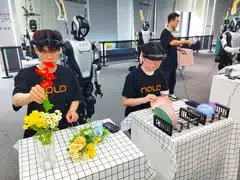
The ambition is part of a wider push to make humanoid robots useful at home. At the World Humanoid Robot Games in Beijing in August, robots competed in less glamorous events alongside sprinting and high jumping: making beds, serving drinks, tidying rooms and folding clothes. One Chinese-designed machine hung laundry, folded garments and collected a package before returning to its chore.

China has established an early lead in humanoids for factories and warehouses, and companies are now pursuing domestic uses. The global personal and household robots market is forecast to reach US$22.1 billion in 2026, up from US$18.1 billion in 2025, and US$90.9 billion by 2033, according to Grand View Research. China accounted for 97 per cent of humanoid shipments in the first half of 2026, data from Smart Analytics Global show.
Shanghai-based Agibot and Hangzhou-based Unitree Robotics led shipments, ahead of Western companies including Tesla, Figure AI and Agility Robotics. The United States has substantially more capital and prominent technology entrepreneurs, while China controls much of the robotics supply chain and has produced founders competing with Silicon Valley firms. That industrial base gives Chinese makers an advantage in building and testing machines at scale, though home use brings a different set of engineering demands.

From vacuum cleaners to household tasks
Jianghao Huo, Dreame’s 29-year-old home strategy lead, joined the company when it was a small startup. She studied computer science at Tsinghua University and worked with Tsinghua Skyworks, a university group that collaborates with industry on AI and robotics. For six years at Dreame, she has worked on algorithms for smart devices used inside homes. She is among a small group of women at the forefront of China’s AI sector.
Huo leads Dreame’s embodied intelligence business as its chief technology officer and heads algorithms for its robot vacuum division. The company shipped 1.5 million robot vacuums in the first quarter. Those products draw on AI capabilities Dreame intends to extend to a wider range of machines.
“I want to build a robot that does everything in the household – cooking, cleaning, laundry, shopping,” Huo said. The point, she added, is to let people choose how to spend the time those chores take. She sees household robotics moving from demonstrations toward practical use, though that transition is still in its early stages.

At a Berlin trade show in September, Dreame presented the Echo S1, a wheeled, one-armed robot designed to handle laundry. It responds to voice commands, sorts clothes by fabric and colour, chooses a wash routine, loads and unloads the washing machine, and puts clothes away. Dreame also showed the Echo P1 performing basic tasks such as moving objects and monitoring the home.

The next planned model is a dual-arm machine that reaches above table height. Dreame says it is intended to clean and organise tabletops and, eventually, operate appliances such as a dishwasher, oven and air fryer. The company hasn’t provided a price or commercial launch date.

Why homes complicate automation
Household settings require robots to cope with varied objects, layouts and routines. Sanjay Sarma, a mechanical engineering professor at the Massachusetts Institute of Technology, says domestic machines need greater dexterity and sensitivity than factory robots, which can work within more standardised conditions. Tasks involving finer motor or cognitive skills are harder to automate, he said; heavy and hazardous work has long been the more accessible target.

Dreame is building its approach around three systems. A perception layer helps a robot sense its surroundings. An AI world model is intended to help it understand how the physical home works. An intelligent control system then connects that understanding to the robot’s body and actions.

Huo describes the home as a web of tasks, objects and relationships rather than a single, repeatable use case. A robot that can pick up one item in a demonstration may still struggle when the item is unfamiliar, the space is cluttered or another household task changes the situation. That gap between a controlled display and reliable daily use is central to the sector’s challenge.
Huo estimates that large-scale use of humanoids in homes is more than two to three years away. Costs will need to fall before the machines become affordable to households. Tesla is developing its Optimus humanoid, and Elon Musk has said he expects robots to become inexpensive enough for households to have one or two. OpenAI also plans to build humanoids; Sam Altman has said, “Everyone should have a personal robot.” Those ambitions illustrate interest in the category, but they don’t resolve the practical questions of price, reliability and usefulness.
Huo’s longer-term vision is for one household robot to coordinate connected appliances and manage tasks such as grocery orders, reducing the need to control each device separately. She hopes household penetration could eventually exceed 70 per cent. For now, Dreame’s prototypes and existing vacuum business show a route into the home, while the difficult work remains: making a machine capable enough, affordable enough and adaptable enough to earn a place in everyday routines.