Perpetual Futures and KPI Contracts Put New Demands on Market Infrastructure
Perpetuals and company KPI contracts are testing liquidity, clearing, risk controls and the systems needed to support longer trading hours.

Perpetual futures and contracts tied to company performance measures are pushing derivatives venues to rethink how they provide liquidity, manage risk and connect trading with clearing. The products differ, but both expose the limits of market infrastructure built around fixed trading hours and familiar contract structures.
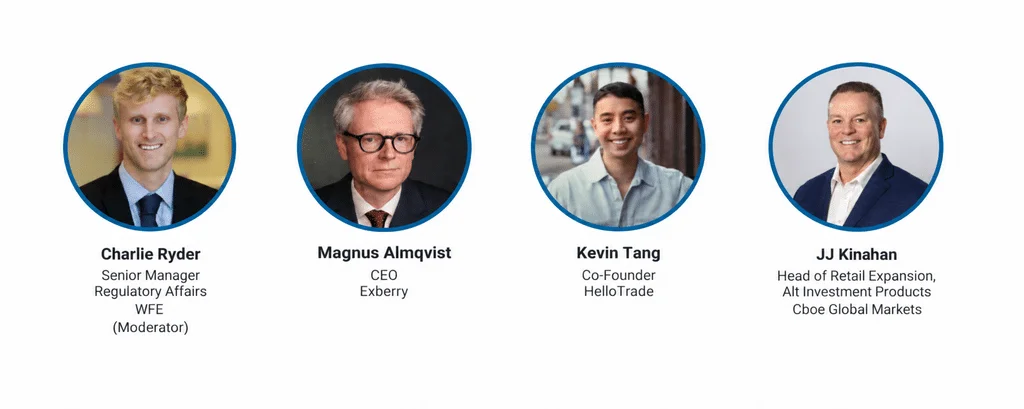
Those issues featured in a World Federation of Exchanges webinar with JJ Kinahan of Cboe Global Markets, HelloTrade co-founder Kevin Tang and Exberry CEO Magnus Almqvist. Their discussion covered perpetual futures, prediction markets, institutional participation and the operational demands of keeping markets open for longer periods.

Perpetuals trade continuously, with a funding cost
Perpetual futures have no fixed expiration date. Instead, a funding mechanism helps keep a contract’s price aligned with its underlying asset. Tang said their capital efficiency, relative simplicity and fit with continuous trading have helped drive their growth in cryptocurrency markets.
That structure also changes what a trader needs to understand. A position can move in the expected direction and still incur funding payments while it remains open. Kinahan warned that this cost may be hard for retail traders to assess, especially over longer holding periods. “You can actually be right,” he said, while still having to make a funding payment.
The distinction matters because a contract’s headline price movement doesn’t capture its full economics. Traders need to understand how the funding mechanism works and how payments affect a position over time. Kinahan said further education would be needed, particularly in the United States.
On blockchain-based platforms, the product design is only part of the launch challenge. Tang said a new perpetual market needs capital, market makers, and enough buyers and sellers to support trading on both sides. That liquidity can be difficult to attract before a platform has an established user base.
Tang sees trading incentives and permissionless participation as ways blockchain platforms can help build liquidity. He also pointed to potential demand from people in emerging and frontier markets who have limited access to traditional brokerage platforms. Those opportunities depend on the venue being able to offer a market that functions reliably as activity grows.
Company measures create a different kind of market exposure
Cboe is exploring contracts tied to corporate key performance indicators, or KPIs. These would let participants take a view on a defined company outcome rather than on the direction of its stock. Kinahan argued that this distinction can matter when a company performs well on a particular measure but its shares fall for other reasons, including market reaction to its outlook.
“What KPIs allow you to do is to really dig down and have an investment opinion on the areas of a company you’re actually observing,” Kinahan said. Cboe is focusing on events it considers financially relevant. “We are not doing sports, we are not doing culture. We’re doing things we feel are truly influencing the market,” he said.
The proposed contracts would require participants to assess the specified measure and the contract’s terms, rather than treating a company’s broader share performance as a substitute. Their appeal will depend in part on whether participants find the outcomes clear and useful enough to trade. Kinahan compared the possible development of this market with zero-days-to-expiration options: retail demand helped draw in market makers, followed by institutional interest.
Clearing is another part of the product design. Cboe has traditionally used the Options Clearing Corporation to clear options. Kinahan said the clearinghouse’s technology modernization meant it couldn’t immediately support the proposed KPI contracts. Cboe was therefore seeking permission to use its own clearing infrastructure. At the time of the webinar, Kinahan said the company had received permission for the product and was awaiting approval for its clearing arrangements.
Longer hours test systems and risk controls
Almqvist said uncertainty across jurisdictions remains one challenge for new products. He also highlighted settlement, risk management and the operating changes required when trading hours expand. Continuous trading affects more than the matching engine: firms must also plan for technology operations, collateral transfers, settlement and internal risk processes.
In his view, exchanges need systems that can handle new instruments and rising volumes while allowing upgrades without interrupting operations. Trading, risk and settlement also need to work closely together. “You need a settlement and risk function that sits very, very closely with your matching engine,” he said.
That approach puts pressure on architectures where the matching engine, collateral management and clearing have historically operated as separate components. It also raises the stakes during event-driven bursts of activity, when trading can cluster around a particular outcome. A venue needs enough capacity to handle those surges, and its risk controls need to respond as quickly as the market does.
Tang said perpetual contracts linked to traditional assets raise a particular concern when reliable price feeds aren’t available outside regular market hours. He pointed to safeguards such as price bands, open interest limits and circuit breakers as tools operators need to consider. Kinahan also stressed that weak risk management at one venue can affect confidence across the broader sector: “If somebody has bad risk management, it actually reflects on the whole industry,” he said.
Institutional interest depends on operational confidence
Hedge funds and institutional market makers already participate in cryptocurrency derivatives, Tang said. For institutions considering on-chain venues, however, technology integration, compliance requirements and smart contract risk remain obstacles. “The biggest blocker right now that I see, especially with on-chain venues, is that there is smart contract risk,” he said.
Traditional portfolio managers are also watching perpetual futures prices over weekends for signals about where underlying markets might open when regular trading resumes. That use makes weekend pricing relevant beyond participants trading the contracts themselves, while still leaving those prices subject to the risks of thinner liquidity and different operating conditions.
Kinahan expects more exchange activity to draw on ideas from blockchain platforms as firms examine extended hours and new clearing arrangements. Tang also expects the markets to move closer together as institutional participation grows. Neither described perpetuals or prediction markets as replacements for established derivatives. “I don’t believe that we will see the end of options and traditional futures,” Tang said.
The next test is practical: whether venues can attract sustained liquidity while keeping prices, settlement and risk controls dependable through longer sessions and sudden bursts of trading. Product design may attract attention, but infrastructure will determine how well these markets work under pressure.


