AI Productivity Gains Could Narrow Workplace Ideas and Collaboration
AI can speed individual work and brainstorming, but researchers warn that reduced colleague contact and more similar ideas may weaken innovation.
AI can help employees produce stronger ideas and reach answers faster. The harder question for companies is whether those gains come at a cost to the conversations and varied thinking that support innovation. Researchers at the Insead AI Forum Asia in Singapore warned that routine reliance on AI could reduce colleague-to-colleague learning and push teams towards a narrower set of ideas.

Martin Gonzalez, Google DeepMind’s head of organisational AI research, called one possible pattern a “self-sufficiency spiral”. Employees who once asked a manager or colleague for help may instead turn to a chatbot. That can make individuals more independent, but it also means fewer chances to exchange knowledge, test assumptions and learn how work gets done across an organisation.
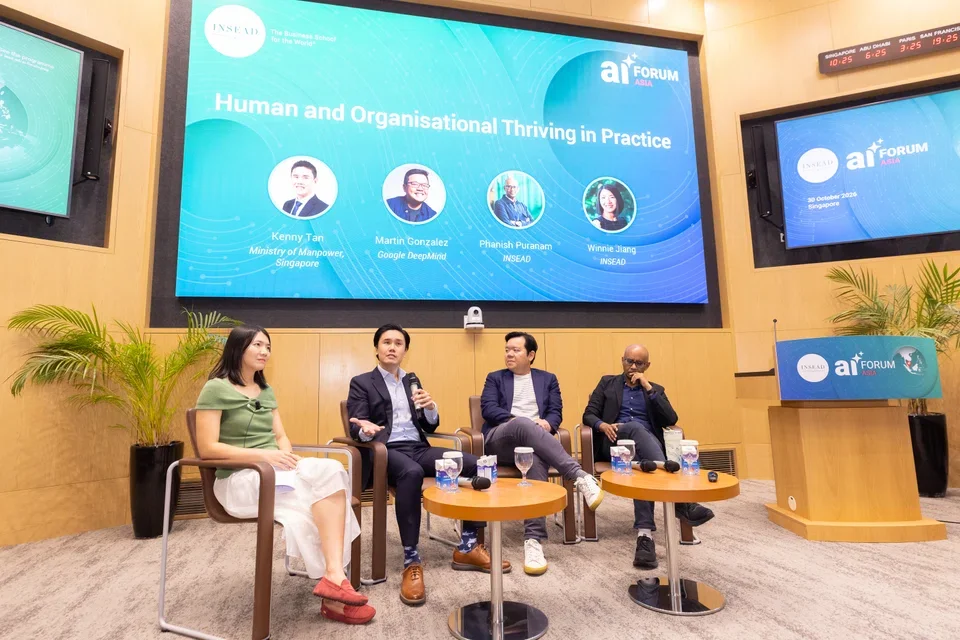
Gonzalez argued that disagreement is part of the process by which teams develop new thinking. “Innovation emerges from a clashing of ideas. In the process of going about that painful kind of back-and-forth, you discover new ideas,” he said. Those exchanges also help pass on workplace culture. If they become less frequent, organisations may need to find other ways to help new employees learn from colleagues and build a shared sense of how to work together.
Faster answers, narrower exploration
The concern is not limited to relationships at work. Phanish Puranam, Insead professor of strategy and the Roland Berger chaired professor of strategy and organisation design, said research suggests AI can improve the quality of ideas produced by individuals while reducing the variety of ideas across a group. “Individual users’ ideas get better. Collective pool of ideas shrink in diversity,” he said. He described that tension as “a collective action problem”.

One possible explanation, Gonzalez said, is that AI models tend to guide users towards established solutions. When different employees ask similar questions and receive responses shaped by familiar patterns, they may arrive at comparable proposals. The result could be better individual output without an equally broad range of options for the organisation to consider.

That distinction matters because an idea’s immediate quality is not the only measure of its value to a team. A group also benefits from generating several different approaches, especially early in a brainstorming exercise, when it is still deciding which problems and possibilities deserve attention. If AI helps people converge sooner, the team may save time while losing routes that could have led to a less obvious answer.

Gonzalez cited preliminary findings from a randomised experiment in which teams completed brainstorming exercises, with some using AI agents. The teams working with AI appeared to converge on ideas around eight minutes faster than teams without the tools. They also explored a narrower range of possibilities and reported feeling less ownership of the ideas they generated.

The findings are still preliminary, and researchers are continuing to collect data, Gonzalez cautioned. They point to a trade-off to examine rather than a settled conclusion about how AI affects every team. The reported difference in convergence time is one outcome; the range of options and participants’ sense of ownership are others. How those measures relate to the eventual quality of a team’s work remains an open question.

Keeping independent thought in the process
How employees use AI may shape that balance. Gonzalez said he avoids using it to write the first drafts of his own work. He prefers to form his ideas first, then use the technology to refine them or challenge his thinking. That sequence preserves an initial stage of independent effort while still allowing AI to contribute later.

Puranam proposed another approach: give employees individually personalised AI tools instead of having a team rely on one shared agent. Because each tool adapts to its user’s context, responses to similar questions could vary. The idea is that this variation might help teams retain a wider mix of perspectives while still giving individuals AI support.
Neither approach resolves the broader organisational question on its own. More personal tools could produce more varied responses, but companies would still need to consider how employees share what they learn and how teams compare ideas. Likewise, reserving early work for people may protect independent thinking, but the right balance could differ across tasks. The forum’s discussion leaves open how firms can capture efficiency while preserving the interaction that helps employees develop and combine ideas.
Research focus turns to learning and connection
The forum was followed by the launch of Insead’s Research Lab for Human and Organisational Thriving, backed by US$3 million in funding from Google.org and Google DeepMind. The lab’s academic director, Winnie Jiang, described thriving as involving both learning and vitality: feeling energised and engaged in meaningful work. “Thriving is not simply about feeling good; it’s also about growing well,” she said.
The lab plans to study learning, working and relating, with the aim of turning its findings into practical approaches for organisations, including those in Singapore. Its agenda reflects the questions raised during the forum: whether employees can benefit from AI while continuing to learn from one another, how work changes when people rely on AI for answers, and what helps organisations sustain meaningful connections as technology becomes more common.
For employers, the useful measure of AI’s workplace impact may therefore extend beyond the speed or quality of an individual’s output. The experiments and research ahead will need to track what teams discover together, how broadly they explore, and whether employees remain engaged with both their work and colleagues.
===END

