Florida Insurance Venture Drew More Than $651,000 in Premiums, Indictment Alleges
Two Destin men pleaded not guilty after an indictment alleged their unlicensed companies collected more than $651,000 in premiums.
The central issue in the case against two Destin men is whether customers paid premiums for coverage from companies that lacked Florida property-casualty licenses and the financial backing required to operate. A federal grand jury has indicted Christopher Jason Brossett, 45, and Brady Allen Howard, 59, on fraud and money laundering charges tied to The Wave Insurance and Hydrogen Deep. The indictment alleges the men took in more than $651,000 in premiums over two years.

The allegations concern two businesses with different histories. The Wave Insurance, described in the indictment as a risk retention group, was incorporated in Florida in 2025. Hydrogen Deep was formed in 2019. Neither company was licensed to operate as a property-casualty insurer in Florida, the indictment says. It also alleges they lacked $5 million in reserves and $4 million in operating funds required under Florida rules.
Those figures point to two separate questions for customers and the insurance market: whether a business had permission to sell the coverage it offered, and whether it had the financial capacity required to operate as an insurer. The indictment alleges that the companies solicited and accepted premiums despite lacking both the required licenses and funds. It further alleges that they supplied falsified certificates of insurance and that the men used the money for personal purposes.
The amounts in the indictment describe alleged premium payments, not a finding about the eventual cost of claims or the financial loss of each customer. The source does not identify the customers, the types of policies sold, the number of certificates issued, or whether any claims were filed. Those details would help establish how the alleged operation affected individual policyholders and businesses that may have relied on proof of coverage.
Case timeline and court status
The indictment follows earlier action in Florida. Brossett and Howard were arrested this summer in Okaloosa County after an investigation involving the Florida Department of Financial Services and the Internal Revenue Service. In September, Florida Insurance Commissioner Mike Yaworsky issued an order directing the men and their companies to stop operating. The order cited the companies’ lack of Florida licenses.
The indictment came four months after the men were charged in connection with operating the insurance business, and roughly a month after the September order. Court records and a bulletin from the U.S. Attorney’s office did not explain why the matter was presented to a federal grand jury after the arrests on state charges. Prosecutors and the lawyers appointed to represent Brossett and Howard could not immediately be reached for comment, according to the source report.
Both men pleaded not guilty at an arraignment on Oct. 16. Their trial is scheduled for Dec. 14 at the federal courthouse in Pensacola. The allegations remain unproven, and the court proceedings will determine how the charges are resolved.
What the records show about Howard
Florida Department of Financial Services records identify Howard as a licensed insurance producer. The records show an appointment with one life insurance company, but none with a property-casualty company. That distinction is relevant to the case’s focus on property-casualty coverage, though the source does not explain Howard’s role in each company or the specific products allegedly sold.
Corporate records also show past connections to Coconut Financial Group, based in Destin, and Bikini Bottom Scuba LLC, in Fort Walton Beach. The source provides no further detail about those businesses’ relationship to The Wave Insurance or Hydrogen Deep. Their mention in corporate records alone does not establish involvement in the alleged conduct.
For customers, the alleged use of certificates matters because such documents can serve as proof of coverage in business dealings. The indictment alleges that certificates were falsified, but does not describe who received them or what decisions were made in reliance on them. For businesses that paid premiums, the unresolved questions include what coverage, if any, they received and whether the payments can be traced or recovered.
The case now turns on evidence concerning the companies’ operations, the premium payments, the certificates and the alleged use of funds. The indictment lays out the accusations; the scheduled trial will provide the next major point at which those claims are tested.
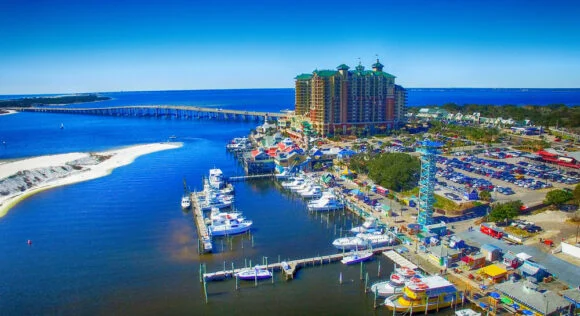
Photo: The resort city of Destin (DepositPhotos)


